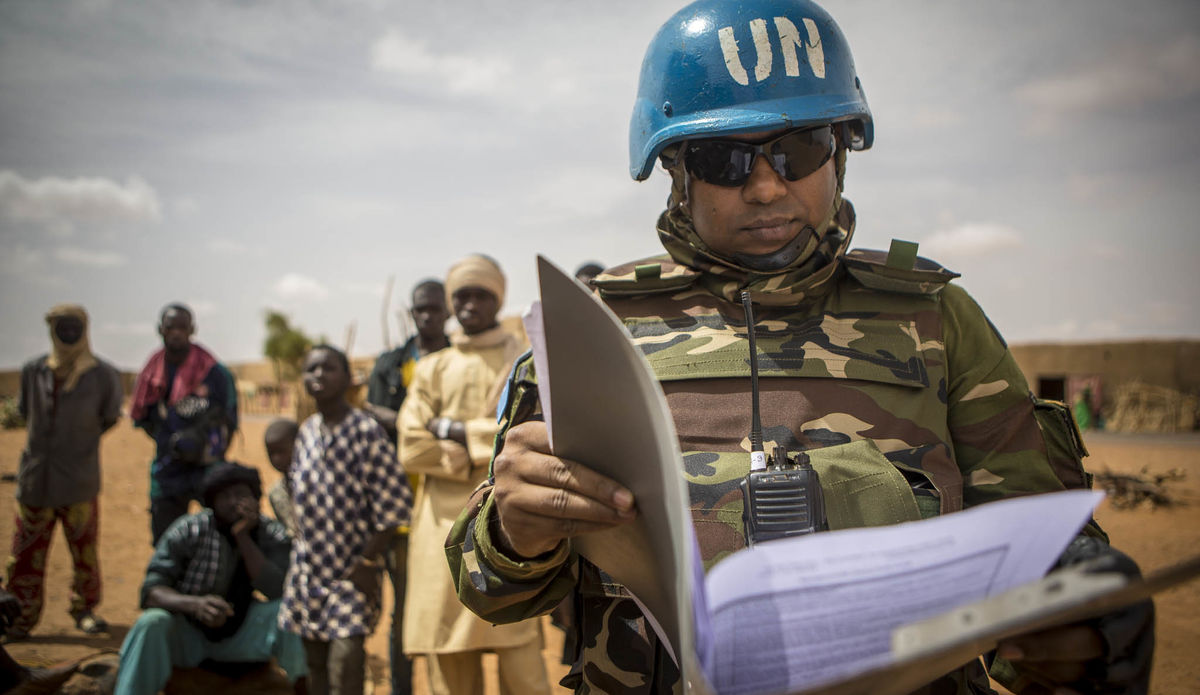
Disturbing The Peace: UN Peacekeepers and Sexual Abuse
Part 3: Echoes of Despair
By Devon Bowers
Part 1 here and Part 2 here.
Author’s Note: This article and series focuses on sexual abuse and assault, with some graphic descriptions of such acts. Reader discretion is advised.
From the tail end of the 20th century and into the new millennium, United Nations have deployed all over the world, to war torn, strife ridden nations with the goal of lessening the violence so peaceful, political solutions could be pursued. Yet, from the very first deployment, UN forces have engaged in heinous, stomach-churning acts of degeneracy which primarily young girls and women have been abused and raped. The situation was actively made worse by the UN itself as it left victims with no recourse and in several instances actively worked to obscure the fact that any abuse had taken place at all.
The events from 1991 in Cambodia, twisting and turning in places such as Bosnia, East Timor, and Haiti, still cast a shadow over UN operations even today.
South Sudan
In 2011, the United Nations Security Council adopted Resolution 1996, under which UN forces would be deployed in order to aid in the creation of a peaceful environment so that the new nation would be able to begin to establish itself politically and economically. Another resolution, Resolution 2155, was later adopted as a coup attempt threw the nation into ethnic strife,[1] with UN troops being tasked with protecting civilian, monitoring human rights violations, and creating safe conditions so humanitarian aid could be delivered.[2]
Early on there were notes made of the difficulties UNMISS was facing regarding training on sexual abuse. A 2013 independent study noted that there were “significant gaps in the induction and refresher training”[3] that occurred between missions, with some not ever receiving the training at all, primarily due to lack of and imperfect communication between the Conduct and Discipline Team and the Integrated Mission Training Center on a local level, whose duty it was to provide said training.
Commanders also proved to be a problem as some of them pushed back against the zero-tolerance policy, choosing to zero in on the “aggressive behavior of women who solicit their troops”[4] instead of the conduct of the soldiers themselves and even requested ‘flexibility’ on the issue of prostitution, despite it being in direct violation of the zero-tolerance rule.
What made the situation worse, as well, was the lack of UN peacekeepers actually conducting their duties. The Star reported in July 2016 that South Sudanese government soldiers had raped dozens of women outside a UN camp and that there was a “reluctance by UN peacekeepers to protect civilians. At least one assault occurred as peacekeepers watched.
On July 17, two armed soldiers in uniform dragged away a woman who was less than a few hundred meters from the UN camp’s western gate while armed peacekeepers on foot, in an armored vehicle and in a watchtower looked on. One witness estimated that 30 peacekeepers from Nepalese and Chinese battalions saw the incident. “They were seeing it. Everyone was seeing it,” he said. “The woman was seriously screaming, quarrelling and crying also, but there was no help. She was crying for help.”[5]
While the peacekeepers themselves weren’t engaging in abuse, it could be argued that they abetted the situation by standing by and doing nothing. This also potentially brings up the question: How often were peacekeepers shirking their duties to the point that national soldiers felt bold enough to rape women near UN camps, much less in front of them?
The following year it seemed that the situation was changing in that the UN was taking a firm stance regarding UNMISS soldiers, stating that there would “be no second chances” for any UN personnel found guilty of sexual abuse and preventing and responding to such cases were a “top priority.”[6] Yet this stance eventually wavered as in the following years. In 2018, Nepalese peacekeepers faced allegation of raping a South Sudanese child. In all, a UN commission investigated sexual abuse allegations by UNMISS soldiers, with 18 peacekeepers being registered in the UN Sexual Exploitation and Abuse Database.[7]
The UN remains in South Sudan to this day.
Mali
In the context of the fourth Tuareg rebellion in Mali[8], UN troops were dispatched to deal with the ongoing violence there beginning in April 2013. While there wasn’t much reporting on the actions of UN peacekeepers in Mali, unfortunately abuse did still take place.
Only months after the mission began did abuse begin to be reported on. BBC reported in September 2013 that four UN peacekeepers were accused of sexually assaulting a Malian woman, with several Malians alleging that multiple women were raped, yet due to the soldiers being from Chad, the UN urged the Chadian government to investigate and discipline the men.[9] The organization was already dropping the ball arguably as it was known for quite some time that nations rarely if ever hold their soldiers accountable.
Central African Republic
In 2014 the UN had taken over operations in the Central African Republic from the African Union[10] force in a country that was dealing with an active civil war.[11]
By 2015, problems were already starting. There was a case here two girls under 16 said they had been forced to exchange sex for food, starting back in 2014.[12] Several months later it was revealed that during a house search, a UN peacekeeper dragged the girl out of the bathroom she was hiding in and raped her.[13]
Sangaris Forces
The Guardian had reported that six pre-teen children told UN staff that they had been sexually abused in exchange food from December 2013 to June 2014 by French soldiers.[14] However, this was a situation where the French troops weren’t under UN control, yet they knew that such acts were ongoing. It was taken so seriously that the Secretary-General even went so far as to set up an independent panel to probe the matter.[15]
The panel was headed by Marie Deschamps, a former Justice on the Canadian Supreme Court, Hassan B. Jallow, a former Minister of Justice and Attorney General in Gambia, and Yasmin Sooka, who had been on the South African Truth and Reconciliation Commission, the Sierra Leone Truth and Reconciliation Commission, and a member of the United Nations Report of the Secretary-General's Panel of Experts on Accountability in Sri Lanka to investigate war crimes in the final stages of the Sri Lankan Civil War.
The abuse was committed by French soldiers, known as the Sangaris Forces for “Operation Sangaris,” not by soldiers under the UN’s command. Still, the organization’s human rights mandate required them to “carry out the interrelated obligations of investigating the allegations; reporting on the allegations internally and, where appropriate, publicly; and following up on the allegations to prevent further abuses and to ensure that perpetrators are held accountable.”[16] The UN had a legal framework in which action could be taken.
A total of six discussions were conducted in which victims of sexual abuse were interviewed. Like so many other soldiers, the French would generally lure victims in with food, with one 9-year-old interviewee saying that
a French soldier working at the check point called him, gave him an individual combat food ration and showed him a pornographic video on his cell phone. The child stated that the soldier then opened his trousers, showing him his erect penis, and asked him to suck his “bangala” (penis). The child told the [Human Rights Officer] that they were seen by another child, who alerted some local delinquents. As a mob was forming, the soldier told the child to run away but the child was caught and beaten. [17]
On several levels, there was a failure of leadership on the part of the UN as they didn’t conduct any further investigation beyond initial interviews and in fact, UN officials assumed that due to the Sangaris forces not being under UN command, the UN “had a limited obligation to respond” to these allegations and because the situation was “politically sensitive” [18] there should be no further exposure than necessary.
In May 2014, the Human Rights and Justice Section (HRJS) was asked by the Office of the High Commissioner for Human Rights to compile a report on African Union soldiers that were supposed to be put under UN control, as many such individuals had been previously accused of serious human rights violations. In this report HRJS also included information of the actions of the Sangaris Forces. Such information should have triggered an emergency report, however, HRJS encouraged the Special Representative of the Secretary-General not divulge the situation. Worse, the HRJS “took no further steps to intervene to stop the violations or to hold the perpetrators accountable.”[19] (emphasis added) So the Section knew that children were being raped and yet did nothing to stop it, effectively becoming complicit in what occurred.
Later, near the end of June 2014, the Human Rights Officer submitted the Sangaris Notes to the head of the HRJS, which, rather than preparing a report and then sending it up to the Special Representative or the High Commissioner’s Office, muddied the waters by putting the information “in a broader report that included a number of allegations of serious human rights abuses—such as killings and torture—by other international troops.”[20] In addition to this, the July 2014 draft report was never finalized or submitted, with the head of HRJS arguing that the Sangrais Notes had already been handed over to the French government, thus there was no further need for involvement.
The Panel
[inferred] from this decision that the purpose of preparing the 17 July 2014 report was to disguise the Allegations so that France was not singled out, and to generate as little attention as possible on the abuses. Unfortunately, this strategy was effective and the report, including the Allegations they contained, went largely ignored. […] The decision of the head of HRJS not to finalize the 17 July 2014 report was a failure of his obligation to follow up not only on the Allegations described in the Sangaris Notes, but also on the other violations of human rights and international criminal law set out in the draft report.[21]
The Central African Republic desk also failed in its duties as between May and June 2014, they received at least five notifications of the allegations against the French, but “took no further steps either to follow up with HRJS or with the [Special Representative for the Secretary-General]”[22] beyond vague wording in a human rights development update.
After the Human Rights Officer took her leave, the HRJS halted the investigation and UNICEF didn’t seek out any additional children despite that four of the children interviewed identified other victims, the children acknowledging that it was public information that French troops would trade sex for food, and indications from the interviews that the abuse was planned and coordinated, among several other flags that should have been cause for alarm. This helps to illuminate the fact that even if serious reforms were made, it doesn’t matter if there is failure at the local level to report on such abuse.
Thankfully, there was a whistleblower in the form of Anders Kompass who leaked “a confidential report documenting the sexual abuse of children by French and African peacekeepers”[23] to the French government. In response, the UN High Commissioner for Human Rights, Prince Zeid Raad al-Hussein of Jordan, asked the Office of Internal Oversight Services to “open an investigation into the matter on the grounds that Kompass ‘had placed the victims of sexual abuse at risk by including their names in the report he provided to the French government’ and that he did so in order to obtain a promotion.”[24] While he was suspended for a time, Kompass was later reinstated.
The French ended their mission in the CAR in October 2016.[25] The following year, the French court system refused to bring charges against the soldiers accused of sexually abusing children, with spokeswoman for the Paris prosecutor’s office, Agnès Thibault-Lecuivre, saying that “the case was particularly difficult because it was based solely on the children’s accounts, without independent evidence” and that there was the problem of identifying people.[26]
Worse, though, was that more evidence of abuse would be uncovered. In March 2016, the Deputy Special Representative of the Secretary-General and a delegation from MINUSCA met with local leaders, where four girls accused the Sangaris force of forcing them to have sex with a dog.
[They] were tied up and undressed inside a camp by a military commander from the Sangaris force and forced to have sex with a dog. Each girl was then given 5000 Central African Francs (approx. $9 USD). The three girls interviewed sought basic medical treatment. The fourth girl later died of an unknown disease. One of the survivors said that she was called “the Sangaris’ dog” by people in the community.[27]
The UN never contested the claims.[28]
There was a separate case that had similarities to UN abuse in the Ivory Coast, where it was found that peacekeepers were paying girls “as little as 50 cents in exchange for sex” and that there was an entire prostitution ring these peacekeepers utilized that “was run by boys and young men who offered up girls ‘for anywhere from 50 cents to three dollars.”[29] Once again, there is the utilization of children as tools to abuse other children.
In early 2016, Human Rights Watch documented a total of eight sexual abuse cases. One of the cases was a gang rape, where a woman was visiting a Republic of Congo troop base, seeking assistance when armed peacekeepers forced her into a bush a raped her. “I didn’t want to have sex with them, but when I went to visit their base, they took me into the bush,” she said. “There were three of them on me. They were armed. They said if I resisted, they would kill me. They took me one by one.”[30] Another involved a 14 year old girl, who was attacked as she was walking by a UN base. She told HRW that the peacekeepers “pulled me into the tall grass and one held my arms while the other one pinned down my legs and raped me.”[31] She began to scream, causing both soldiers to run away before she could be raped a second time.
As time wore on, more abuses from the past came to light,[32] however, the biggest shock came in 2017, revolving around an entire battalion.
The issue involved about 650 Congolese soldiers whose “alleged indiscipline, poor leadership, repeated involvement in sexual exploitation and abuse cases, and overall threadbare competence”[33] was creating major headaches for the UN Secretary General Antonio Guterres. The UN mission filed an official assessment of the unit, known as COGBAT 3, which found that 120 personnel from CONGO Batt 2 and 1 from CONGO Batt 3 were repatriated to [their] home country on SEA cases.”[34] In a memo to the UN peacekeeping military advisor, Lieutenant General Carlos Humberto Loitey, the force commander of the mission, LTG Balla Kieta, lamented that “the situation has deteriorated to the point that the battalion is no longer trustable because of poor leadership, lack of discipline, and operational deficiencies.”[35] Despite having discipline break down in an entire battalion to the point that it was being discussed at the highest levels, not to mention the effect it was having on the local populace, all that came of it was that the UN had shared the evaluation with the Congolese government and the situation was being followed up on.
Bombshells continued to drop with the Code Blue campaign accusing the UN of mishandling sexual abuse cases, based on leaked case files which revealed that out of 14 cases that the UN was investigated in 2016, there were eight such cases in which the victims weren’t even interviewed, which could have resulted in cases being thrown out before they were thoroughly investigated.[36] In that same vein, when the UN dispatched investigators to look into rapes and sexual abuse done by Burundian and Gabonese peacekeepers, more than half of the 130 allegations would end up being dismissed. An internal UN report was uncovered in 2019 which found a laundry list of problems with the investigations, “– from the Burundians discrediting their testimony to the UN failing to ask crucial follow-up questions that could have corroborated their accounts.” More specifically the report found that:
UNICEF failed to take accurate victim testimonies and waited weeks before informing the UN’s investigatory and oversight body of the allegations.
The UN failed to provide basic security for investigators.
The atmosphere for women and girls making the allegations was described as “threatening”, with one investigator reportedly asking a woman about her alleged perpetrator: “Did you love him?”
The system of DNA collection and storage allowed samples to decay – specimens that could have identified alleged perpetrators.[37]
To make matters worse, Ben Swanson, the OIOS director who ordered and oversaw the report, attempted to sway The New Humanitarian from publishing an article on the matter saying that it was a draft report, it was “potentially damaging as written,” and even had the gall to argue that the results of the investigations were “quite good”[38] while utterly failing to discuss why most cases were dismissed or why so many cases involving Gabon soldiers were pending four years later.
There were major structural problems with the investigation, the largest one being that the Burundians were allowed to conduct them, a massive conflict of interest, which led them to be “more concerned with discrediting witnesses than taking their testimonies,” with interviews being described as “interrogatory” and involving “questions and comments described as “humiliating,” “irrelevant,” and “incongruous.”[39] Due to the lack of concern with the investigators, they failed to ask crucial follow-up questions which would have led to greater information awareness and a more detailed investigation, it resulted in a Burundian peacekeeper who had allegedly raped a women being cleared. The interviews were so plagued with problems that “they would have serious implications for any subsequent legal proceedings.”[40]
In spite all of this, the United Nations remains in the Central African Republic to this day.
Solutions?
Among all of this discussion, what has yet to be addressed is the idea of solutions. Though it would be easy to point to the UN and simply argue that the organization as a whole simply need to actually enforce its own rules, something that does need to occur, there needs to be an examination as to why it is so difficult to bring peacekeepers to justice and how victims can be taken care of.
First, what should be examined is the specifics of soldiers that are under UN command. Peacekeeping troops are loaned to the UN from troop-contributing countries and while they serve under UN command, their home countries are responsible for disciplining them based on a Memorandum of Agreement between the two entities. From there, the UN organizes a Status of Forces Agreement (SOFA) with the government of the country the soldiers are to be deployed to where the host nation “waives jurisdiction over peacekeepers for violations of host-nation law,” this results in a situation where troops have “de facto immunity from prosecution there.”[41] On paper, soldiers have immunity when working in an official capacity, but in reality, they are immune from local law.
TCCs refuse to exercise their legal authority and thus many peacekeepers commit horrid acts and go about their way. Even when TCCs do want to prosecute their soldiers, investigations are done so poorly and conducted in such a manner that doesn’t apply to their respective law, with evidence be inadmissible in court or so lacking that it wouldn’t sustain a conviction, that the case can easily be thrown out.[42]
It should be noted that the application of immunity can be waived. Within the SOFAs lie a clause which expounds upon the privileges and immunities for peacekeepers, with the general rule being that “basic privileges and immunities of a [UN] peacekeeping operation flow from the Convention of the Privileges and Immunities of the [UN],”[43] with the Convention specifying that such immunity only applies when soldiers are acting in official capacities.
For example, the SOFA dealing with the UN Mission in East Timor granted military personnel “immunity from Indonesian criminal and civil jurisdiction, and local criminal and civil jurisdiction,” however, due to the operation being considered an organ of the UN, peacekeepers fell “under the Convention on Privileges and Immunities, which means that immunities should still be able to be waived by the Secretary-General for any offences committed.”[44]
Thus, if peacekeepers do engage in crimes such as rape, forced prostitution, sexual abuse, and the like, the UN can actually waive that immunity due to such actions being outside of official duties. Therefore, there should be pressure on the UN to utilize its power to waive the immunity of peacekeepers accused of sexual abuse.
So, the question arises: If a peacekeeper can’t be punished by the laws of their respective country, can they be punished by international law?
Generally speaking, the International Criminal Court (ICC), deals with crimes that occur before and during conflicts, so for UN peacekeepers to be brought up on charges for sexual abuse by the ICC would not only be “a historic exercise of judicial authority,”[45] but also would send a message globally that peacekeepers engaging in sexual abuse would be bought to justice.
Renee Vezina, of the Ave Maria School of Law argues that there is some merit to this idea as the Rome Statute focuses on human rights violations or crimes against humanity, “which includes rape, sexual slavery, enforced prostitution, forced pregnancy, enforced sterilization, or any other form of sexual violence of comparable gravity.”[46] This legal standing was already around since 1998 with “prosecution of individuals at the international level on the crime of rape” in the “International Criminal Tribunal for Rwanda, when Jean Paul Akayesu was convicted for crimes against humanity for his encouragement of the rape of Tutsi women,”[47] which was upheld in the Appeals Chamber.
There are some serious challenges to use of the ICC, however. Its statute gives it jurisdiction on crimes against humanity, genocide, and war crimes, yet, each of these has its own definition that would limit the prosecutor’s options. Take the aforementioned idea of charging accused UN peacekeepers with crimes against humanity. That term “involves the commission of an attack that is inhumane in nature, causing great suffering, or serious injury to body, or to mental or physical health. The act must be committed as part of a widespread [“an attack directed against a multiplicity of victims”] or systematic attack [an attack carried out pursuant to a preconceived policy or plan”] against members of a civilian population.”[48] A second limitation is that the specific act “must be carried out ‘pursuant to or in furtherance of a State or organizational policy to commit such attack,”[49] meaning that the crimes engaged in must be done in pursuit of a large policy.
Furthermore, the ICC acts in a complementary nature to national courts, only taking jurisdiction of cases if national courts don’t do so first or if they are unwilling/unable to prosecute, due to a breakdown in its judicial system, for example. To this end, Article 18 of the Rome Statute
requires that the prosecutor of the ICC must notify all states parties and states with jurisdiction over the case before beginning an ICC investigation and cannot begin an investigation on his own initiative without first receiving the approval of a chamber of three judges.
At this stage, it would be open to states that are party to the statute to insist that they will investigate allegations against their own nationals themselves. Should this national be a peacekeeper (for example a South African peacekeeper alleged to be guilty of an ICC crime in the DRC), in such a situation the ICC must then suspend its investigation.[50]
Thus, the Court’s hands are tied if the court of troop contributing nations decided to take up the case, even if that national court lets the alleged abuser off the hook.
There may be a way of balancing the powers of a national court with the powers of the ICC in the form of a hybrid court, a court that can prosecute international crimes. A hybrid court is such because “both the institutional apparatus and the applicable law consist of a blend of the international and the domestic,” with foreign and domestic judges sitting side by side with cases being “prosecuted and defended by teams of local lawyers working with those from other countries.”[51] Such a system was used to some effect in Kosovo and in East Timor.[52]
With regards to addressing the pain of victims, there is the idea of a truth and reconciliation commission, which “have been used in Latin America, Central and Eastern Europe, and parts of Africa” and are focused primarily on “the right to truth and a victim-centered approach.”[53] This isn’t enough to address the abuses of UN peacekeepers, but it would provide a start where information could be brought to light, accountability has the potential to take place, and victims can confront their abusers in the open.
These ideas won’t solve the past outright, but it could change future UN peacekeeping operations. May be the echoes of despair would finally cease.
Endnotes
[1] Sudarsan Raghavan, “Divisions in South Sudan’s liberation movement fuel war,” Washington Post, December 27, 2013 (https://www.washingtonpost.com/world/africa/divisions-in-south-sudans-liberation-movement-fuel-war/2013/12/27/71347da2-6f31-11e3-a5d0-6f31cd74f760_story.html)
[2] United Nations, Security Council, Resolution 2155, S/Res/2155, March 27, 2014 (https://www.un.org/en/ga/search/view_doc.asp?symbol=S/RES/2155(2014))
[3] Thelma Awori, Catherine Lutz, Paban J. Thapa, Final Report: Expert Mission to Evaluate Risks to SEA Prevention Efforts in MINUSTAH, UNMIL, MONUSCO, and UNMISS, https://web.archive.org/web/20150709034934/http://www.aidsfreeworld.org/Newsroom/Press-Releases/2015/~/media/Files/Peacekeeping/2013%20Expert%20Team%20Report%20FINAL.pdf (November 3, 2013), pg 8
[4] Ibid, pg 18
[5] Jason Pantikin, “Dozens of women raped by South Sudan soldiers near UN camp: witnesses,” The Star, July 27, 2016 (https://www.thestar.com/news/world/2016/07/27/dozens-of-women-raped-by-south-sudan-soldiers-near-un-camp-witnesses.html)
[6] United Nations Permanent Mission, UNMISS: 'No second chances' for sexual exploitation and abuse, https://www.un.int/news/unmiss-no-second-chances-sexual-exploitation-and-abuse (October 3, 2017)
[7] UN News, South Sudan: ‘Outraged’ UN experts say ongoing widespread human rights violations may amount to war crimes, February 20, 2019 (https://news.un.org/en/story/2019/02/1033181)
[8] Devon Bowers, Rebellion, Resources, and Refugees: The Conflict in Mali, http://www.whataboutpeace.com/2013/02/rebellion-resources-and-refugees.html (February 28, 2013)
[9] BBC, UN's Minusma troops 'sexually assaulted Mali woman', https://www.bbc.com/news/world-africa-24272839 (September 26, 2013)
[10] David Smith, “UN takes over peacekeeping in Central African Republic,” The Guardian, September 16, 2014 (https://www.theguardian.com/global-development/2014/sep/16/un-peacekeeping-central-african-republic)
[11] Thierry Vircoulon, Failure Has Many Fathers: The Coup in Central African Republic, Relief Web, https://reliefweb.int/report/central-african-republic/failure-has-many-fathers-coup-central-african-republic (March 28, 2013)
[12] France 24, UN peacekeepers accused in new child sex abuse claims, June 24, 2015 (https://www.france24.com/en/20150624-un-peacekeepers-accused-new-child-sex-abuse-claims-car)
[13] Amnesty International, CAR: UN troops implicated in rape of girl and indiscriminate killings must be investigated, August 11, 2015 (https://www.amnesty.org/en/latest/news/2015/08/car-un-troops-implicated-in-rape-of-girl-and-indiscriminate-killings-must-be-investigated/)
[14] France 24, UN to probe ‘disturbing’ handling of CAR child sex abuse claims, June 6, 2015 (https://www.france24.com/en/20150603-un-independent%20-investigation-child-sex-abuse-car-peacekeepers-france)
[15] United Nations Secretary-General, Statement Attributable to the Secretary-General on allegations of sexual abuse in the Central African Republic, https://www.un.org/sg/en/content/sg/statement/2015-06-03/statement-attributable-secretary-general-allegations-sexual-abuse (June 3, 2015)
[16] Marie Deschamps, Hassan B. Jallow, Yasmin Sooka, Taking Action on Sexual Exploitation and Abuse by Peacekeepers: Report of an Independent Review on Sexual Exploitation and Abuse by International Peacekeeping Forces in the Central African Republic, https://web.archive.org/web/20151217183752/https://www.un.org/News/dh/infocus/centafricrepub/Independent-Review-Report.pdf (December 17, 2015), pg 28
[17] Ibid, pg 17
[18] Ibid, pg 28
[19] Ibid, pg 33
[20] Ibid, pg 34
[21] Ibid, pg 35
[22] Ibid
[23] Colum Lynch, The U.N. Official Who Blew the Lid off Central African Republic Sex Scandal Vindicated, Foreign Policy, https://foreignpolicy.com/2015/12/17/the-u-n-official-who-blew-the-lid-on-central-african-republic-sex-scandal-vindicated/ (December 17, 2015)
[24] Government Accountability Project, Foreign Policy: UN Drops Leak Investigation Into Human Rights Official In C.A.R. Sex Scandal, https://whistleblower.org/in-the-news/foreign-policy-un-drops-leak-investigation-human-rights-official-car-sex-scandal/ (January 19, 2016)
[25] BBC, France ends Sangaris military operation in CAR, https://www.bbc.com/news/world-africa-37823047 (October 31, 2016)
[26] Benoît Morenne, “No Charges in Sexual Abuse Case Involving French Peacekeepers,” New York Times, January 6, 2017 (https://www.nytimes.com/2017/01/06/world/africa/french-peacekeepers-un-sexual-abuse-case-central-african-republic.html)
[27] Code Blue, Shocking New Reports of Peacekeeper Sexual Abuse in the Central African Republic, March 30, 2016 (http://www.codebluecampaign.com/press-releases/2016/3/30)
[28] Samuel Oakford, “French Peacekeepers Allegedly Tied Up Girls and Forced Them Into Bestiality,” Vice, March 31, 2016 (https://www.vice.com/en/article/a398za/french-peacekeepers-allegedly-tied-up-girls-and-forced-them-to-have-sex-with-dogs)
[29] Kevin Sieff, “U.N. says some of its peacekeepers were paying 13-year-olds for sex,” Washington Post, January 11, 2016 (https://web.archive.org/web/20160112032806/https://www.washingtonpost.com/world/africa/un-says-some-of-its-peacekeepers-were-paying-13-year-olds-for-sex/2016/01/11/504e48a8-b493-11e5-8abc-d09392edc612_story.html)
[30] Human Rights Watch, Central African Republic: Rape by Peacekeepers, https://www.hrw.org/news/2016/02/04/central-african-republic-rape-peacekeepers (February 4, 2016)
[31] Ibid
[32] Sandra Laville, “UN inquiry into CAR abuse claims identifies 41 troops as suspects,” The Guardian, December 5, 2016 (https://www.theguardian.com/world/2016/dec/05/un-inquiry-into-car-abuse-claims-identifies-41-troops-as-suspects)
[33] George Russell, “Peacekeeper battalion in Central African Republic challenges UN 'war' on sexual abuse,” Fox News, https://www.foxnews.com/world/peacekeeper-battalion-in-central-african-republic-challenges-un-war-on-sexual-abuse (June 9, 2017)
[34] United Nations, Mission Field Headquarters In Mission Operational Readiness Assessment of COGBAT 3, (https://static1.squarespace.com/static/514a0127e4b04d7440e8045d/t/593704a2579fb37a23567889/1496777906180/MINUSCA+ORA.pdf), pg 8
[35] United Nations, MINUSCA- Lack of Professionalism in the Congolese Contingent, May 12, 2017 (https://static1.squarespace.com/static/514a0127e4b04d7440e8045d/t/593704c246c3c490c3ee0b24/1496777924587/CAR+memo.pdf)
[36] Krista Larson, “Group: UN mishandling Central African Republic abuse claims,” Associated Press, September 14, 2017 (https://apnews.com/article/e292fc4299f741629661fd67754050ef)
[37] Paisley Dodds, Phillip Klenfield, “Blunders in Central African Republic sex abuse probe detailed in internal UN review,” The New Humanitarian, October 31, 2019 (https://www.thenewhumanitarian.org/investigations/2019/10/31/Central-African-Republic-sex-abuse-probe-internal-UN-review)
[38] Ibid
[39] Ibid
[40] Ibid
[41] Keith J. Allred, “Peacekeepers and Prostitutes: How Deployed Forces Fuel the Demand for Trafficked Women and New Hope for Stopping It,” Armed Forces & Society 33:1 (October 2006), pg 9
[42] Ibid, pg 10
[43] Renee Vezina, “Combating Impunity in Haiti: Why the ICC Should Prosecute Sexual Abuse by UN Peacekeepers,” Ave Maria International Law Journal 1:2 (2012), pg 450
[44] Melanie O’Brien, Overcoming boys-will-be-boys syndrome: Is prosecution of peacekeepers in the International Criminal Court for trafficking, sexual slavery and related crimes against women a possibility? Lund University Publications, http://lup.lub.lu.se/student-papers/record/1554856 (2004), pgs 39
[45] Vezina, pg 446
[46] Ibid
[47] Ibid
[48] Stephen Pete, Max Du Plessis, “Who Guards The Guards,” African Security Review 13:4 (2004), pg 10
[49] Ibid
[50] Ibid, pg 13
[51] Laura A. Dickinson, “The Promise of Hybrid Courts,” The American Journal of International Law 97:2 (April 2003), pg 295
[52] Rosa Freedman, “Unaccountable: A New Approach to Peacekeepers and Sexual Abuse,” The European Journal of International Law 29:3 (2018), pg 978
[53] Ibid, pg 980